
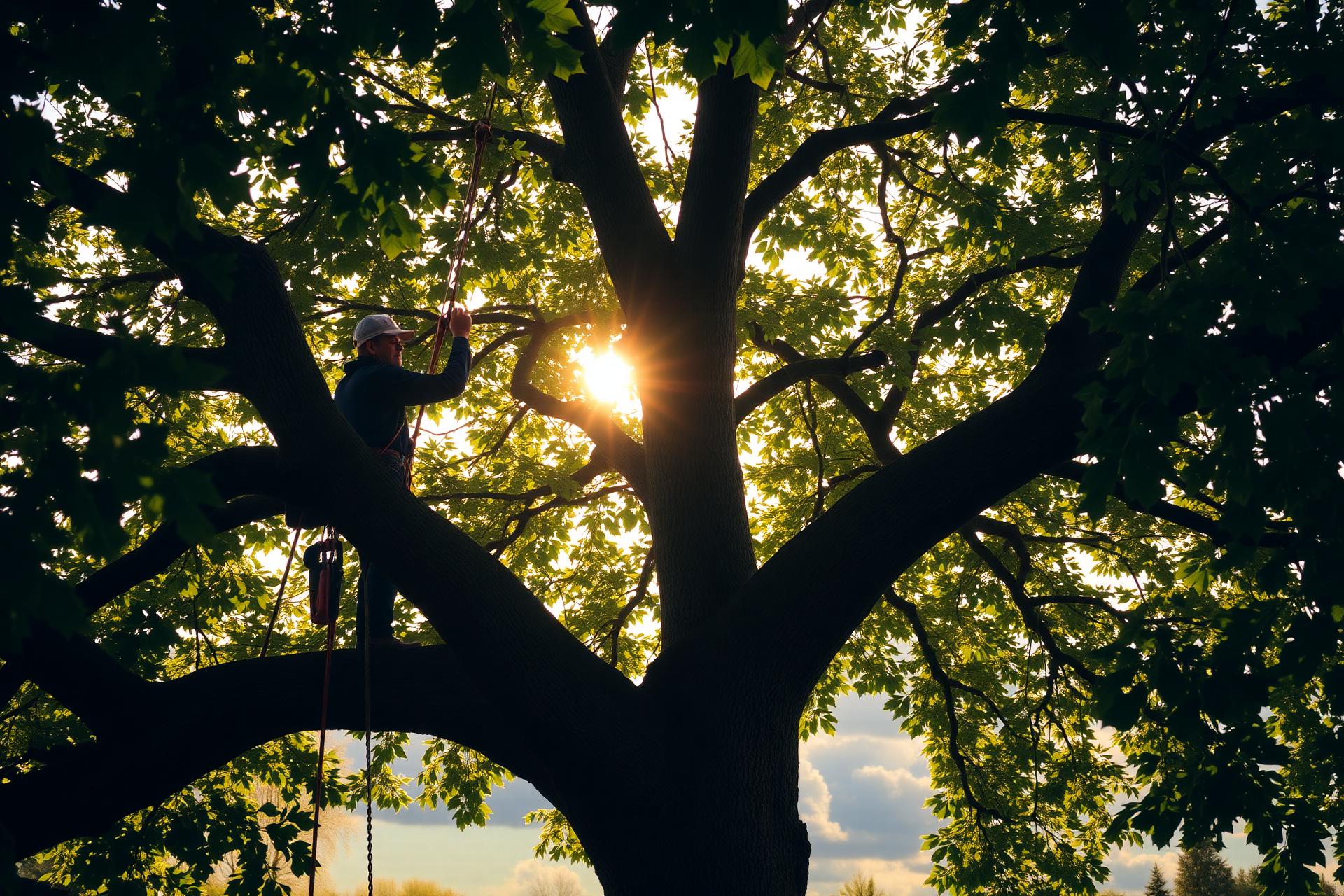
Trees don't send emails. They communicate differently: a limb leaning a bit further than it did last summer, gutters filling with debris that shouldn't be there, a shadow that has swallowed the lawn where nothing grows anymore. Most homeowners wait longer than they should, and by the time they pick up the phone, the job is larger and more expensive than it needed to be.
Crown reduction brings a tree back to a manageable size while keeping it structurally sound and healthy. A good arborist reduces the canopy by a defined percentage, typically no more than 30% in a single visit, cutting back to suitable lateral branches and retaining the tree's natural form. It is not tidying up. It is surgery, and the Arboricultural Association classes it as one of the most technically demanding operations in arboriculture.
Here are the seven signs it is time to book it.
1. Branches are touching the building
A branch making contact with a roof is not a nuisance. It is a route for moisture, moss growth, and, in the wrong conditions, structural damage. Branches rubbing against gutters accelerate wear and push debris into downpipes. Against tiles, they lift and crack. If there is contact during calm weather, the tree has already outgrown its space. Contact only during high winds gives you a bit more runway, but not much. A lateral reduction pulls the canopy back from the building line.
2. The crown is visibly lopsided or has a heavy lean
Trees grow toward light. Over time, the crown can become asymmetrical in ways that shift the centre of gravity and put uneven stress on the root system. A heavily weighted crown increases the mechanical load on the trunk and the soil anchor. An overall reduction restores balance before that becomes a structural concern.
3. Dead or dying branches are appearing in the upper crown
One or two dead branchlets is normal. A pattern of dieback in the upper crown, where the tree is struggling to supply water and nutrients to its extremities, suggests the tree has grown beyond what its root system can comfortably sustain. Reducing the crown eases that demand. Left alone, the dead wood will eventually fall. Trees tend not to choose convenient moments for that.
4. The tree is blocking significant light to the property
This is the most common reason people call. If a south-facing garden has become permanently shaded, or rooms that once had morning light no longer do, the tree has reached a point where it is affecting the practical use of the property. A reduction of 20–30% of the crown can make a material difference to light levels without removing the tree and without dramatically changing its appearance.
5. Recent growth has been vigorous and vertical
Some species, particularly limes and sycamores, put on rapid vertical growth. A tree that has added several metres in height since its last assessment is worth reviewing. Fast vertical growth often means the crown is becoming top-heavy relative to its lateral spread. A vertical reduction brings the leaders back to a sound lower lateral.
6. The tree sits near overhead cables or infrastructure
Network operators have clearance requirements for trees growing near power lines and telecommunications infrastructure. If a tree is approaching or touching overhead cables, the options narrow quickly. Work done proactively, on your terms, is invariably preferable to an operator stepping in with a far blunter approach.
7. It hasn't been assessed in more than five years
This is the quiet one. Trees change. A well-proportioned tree from five years ago may have grown significantly, developed new structural issues, or begun to decline in ways that are not obvious from the garden. The Arboricultural Association recommends regular inspection for mature trees, frequency depends on species, age, and location, but five years is a reasonable outer limit for most garden specimens.
Any one of these signs on its own might warrant a call. Several together suggest some urgency. The one thing that rarely helps is waiting, trees that need reduction work do not settle back to a comfortable size on their own.
Think your tree might need attention? Get in touch and we'll arrange an assessment.