
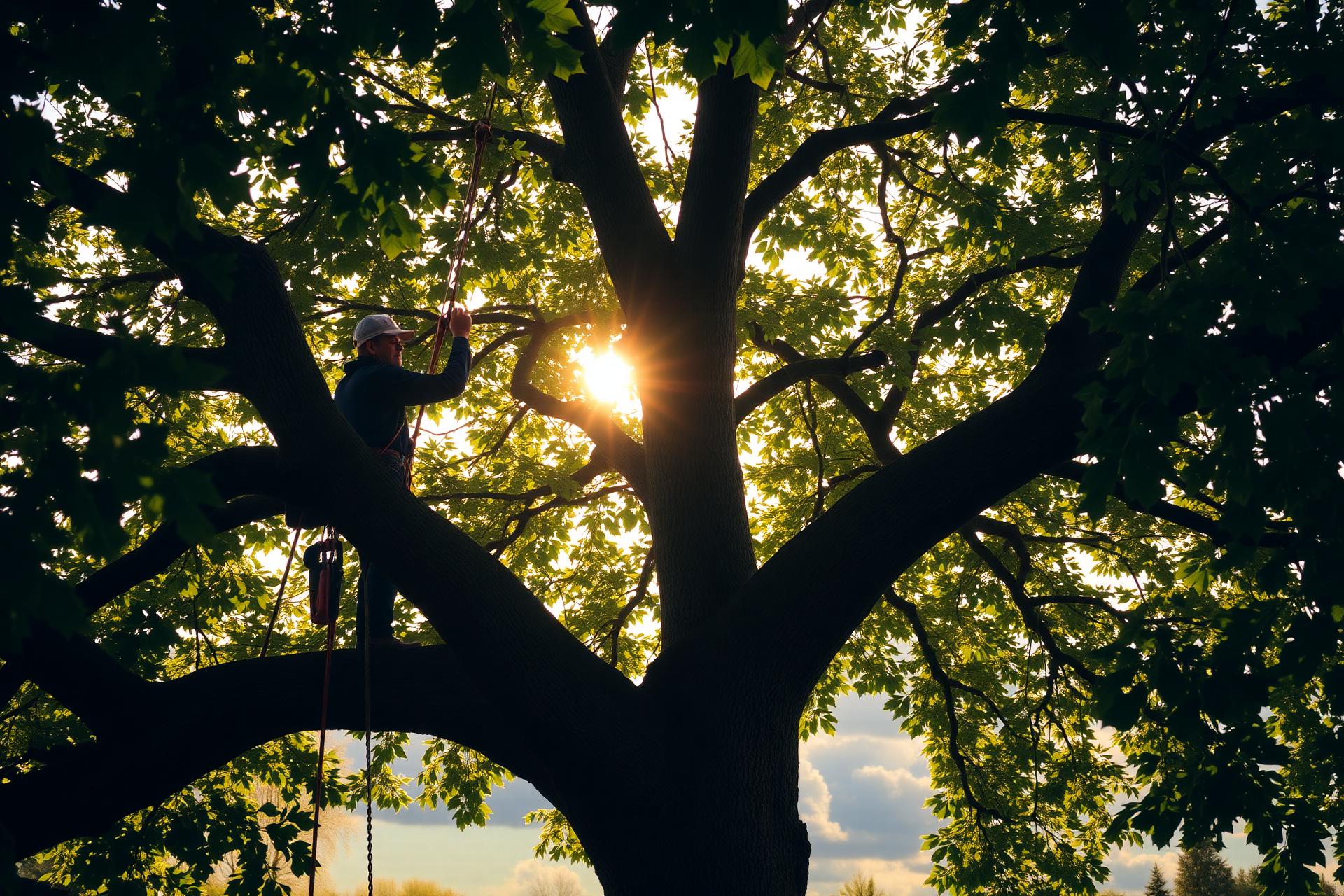
Crown Reduction for Oak Trees
Quercus robur · also known as English Oak, Pedunculate Oak
The most common large tree in English gardens. And one of the most commonly protected.
Mature height
20–28m
Mature spread
15–25m
Annual growth
20–40cm
Max recommended reduction
25% per visit
Why reduce a oak
The case for reduction
Oaks grow slowly but reach significant size. In gardens where they were planted decades ago, or that were built around existing trees, they frequently overhang neighbouring properties, block light to the south face of the house, or have branches approaching rooflines. Because mature oaks are commonly TPO-protected, removal is rarely straightforward, making managed crown reduction the primary long-term tool.
Species profile
- Mature height
- 20–28m
- Mature spread
- 15–25m
- Growth rate
- Slow to moderate
- Annual growth
- 20–40cm per year
- Lifespan
- 500+ years
- Commonly found in
- Large gardens, estates, parks, field boundaries, churchyards
- TPO likelihood
- Very high, one of the most commonly protected species in England
- Clay planting distance
- 30m on high-shrinkage clay (NHBC Zone H)
How it responds
- Tolerance
- Good, Oak tolerates crown reduction well when work is done to BS 3998:2010 and cuts are made to suitable lateral branches. It does not respond well to topping or heavy-handed work.
- Regrowth vigour
- Moderate, Regrowth after reduction is steady rather than explosive. Follow-up work is typically required every 4–6 years on a managed programme.
- Max reduction
- 25% per visit, No more than 25% of the crown should be removed in a single visit. Over-reduction stresses the tree and can trigger poor-quality epicormic regrowth.
When to do the work
Best season: Late winter, January and February are ideal. Tree is fully dormant. Wounds begin to callus as growth resumes in spring. Fungal spore counts are low.
Avoid: June to August in areas where oak processionary moth (OPM) is established. OPM caterpillar hairs pose a health risk. The moth is currently established across London and parts of the south-east. Check Forest Research's OPM distribution maps before scheduling summer work.
Nesting: A nest check is legally required before any work between March and August under the Wildlife and Countryside Act 1981.
Warning signs to look for
- • Overhanging branches making contact with or within 2m of the roof or gutters
- • Progressive shading of south-facing garden or lawn, noticeably worse year on year
- • Deadwood appearing in the upper crown, oak often signals stress this way
- • The tree hasn't been assessed since before its TPO was issued
Disease & pest notes
Oak processionary moth (Thaumetopoea processionea) is the primary consideration for work timing in the south-east. Acute oak decline (AOD) and chronic oak decline are also present in some areas, an arborist should assess tree health before specifying reduction on a visibly stressed specimen. Report suspected OPM to the Forestry Commission.
Aftercare
Oak produces relatively restrained epicormic regrowth compared with lime or sycamore. Monitor cut points for callus development over the first two growing seasons. No wound sealant should be applied. A follow-up inspection at 3–5 years is appropriate for most specimens.
Legal considerations
Mature oaks are among the most frequently TPO-protected trees in England. Always check with the local planning authority before commissioning work. Work on a TPO oak without consent is a criminal offence carrying fines of up to £20,000 on conviction.
Cost indicator
High, mature oaks typically require specialist access equipment, significant time, and experienced arborists. Expect a higher day rate than for most garden trees.
FAQs
Oak reduction questions
Can I reduce my oak tree if it has a TPO?
Yes, with consent from your local planning authority. You apply through the Planning Portal and the LPA has 8 weeks to determine the application. A supporting arborist's report strengthens the case significantly.
How much can an oak be reduced in one visit?
No more than 25% of the live crown in a single operation. Removing more than this in one visit stresses the tree and is outside best practice guidance (BS 3998:2010).
Will my oak grow back quickly after reduction?
Moderately. Oak is not as vigorous a re-grower as lime or sycamore. You can expect a follow-up visit to be needed within 4–6 years rather than 2–3.
Other species
Browse more trees
Sycamore
Acer pseudoplatanus
Fast, vigorous, and seemingly everywhere. Sycamore is the tree that never quite fits the space it's been given.
Common Lime
Tilia × europaea
The most forgiving tree to reduce. Also the one that grows back fastest.
Poplar
Populus spp.
Fast, tall, and frequently planted too close to everything.
Tree outgrown its setting? Let's reduce it properly.
Free no-obligation site visit, fixed quotes, UK-wide coverage.