
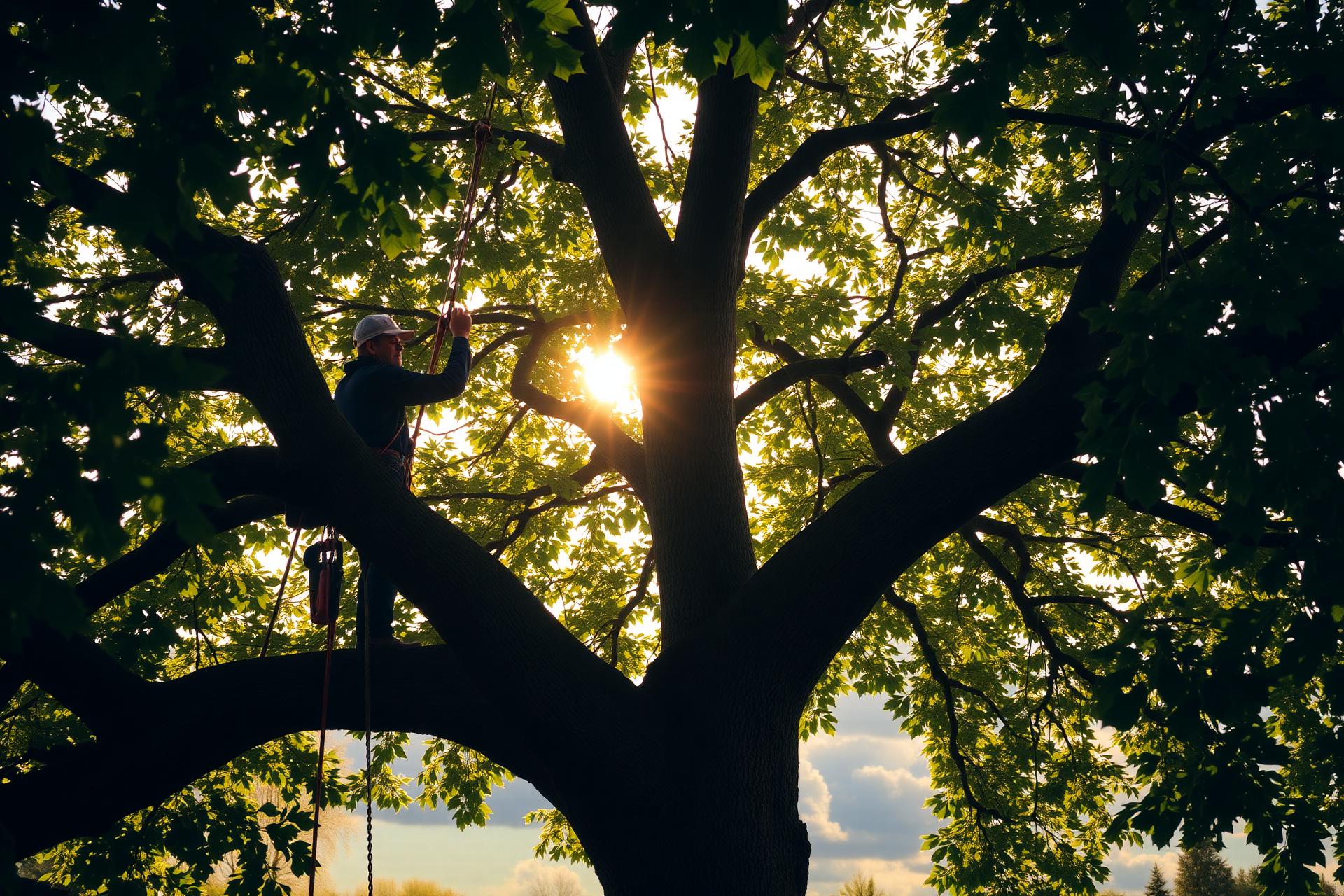
Before any reduction work happens on a significant tree in England, there is a decent chance that planning law is involved. Most homeowners do not realise this until they are already in the process of booking a contractor, which is not the ideal moment to find out.
The rules are not complicated, but they are strict. Getting this wrong carries real consequences: fines, enforcement notices, and in some cases a legal requirement to replace the tree at your own cost. This guide explains what the different protections mean, when they apply, and what you need to do before work starts.
The two main protection types
Tree Preservation Orders (TPOs)
A Tree Preservation Order is a formal legal protection made by a local planning authority (LPA) under the Town and Country Planning Act 1990. A TPO can protect an individual tree, a group of trees, or woodland. The protection means that consent from the LPA is required before any work can be carried out, including crown reduction, crown lifting, pruning, and felling.
You can check whether a tree has a TPO by contacting your local council's planning department or searching on the council's planning portal. Many councils now publish TPO registers online.
Conservation areas
If a property sits within a designated conservation area, a different set of rules applies. Any tree in a conservation area with a trunk diameter of 75mm or more (measured at 1.5m from the ground) is subject to a notification requirement. You must give the LPA six weeks' written notice before carrying out any work.
This is not an application for consent, it is notification. The LPA uses the six-week period to decide whether to make a TPO on the tree. If they do, the tree then falls under the full TPO regime. If the six weeks pass without a TPO being made, work can proceed.
What you need to do: a quick reference
| Your situation | What is required before work |
|---|---|
| Tree has a TPO | Apply to the LPA for consent; wait for approval (typically 8 weeks) |
| Tree in a conservation area, no TPO | Give 6 weeks' written notice to the LPA |
| Tree covered by both a TPO and in a conservation area | TPO rules take precedence; apply for consent |
| Trunk diameter under 75mm at 1.5m (conservation area) | Exempt from notification |
| Dead tree with a TPO | Work can proceed; notify the LPA in writing before starting |
| Emergency work required (e.g. dangerous hanging limb) | Work can proceed; notify the LPA immediately afterward |
How to apply for TPO consent
Applications for consent to carry out work on a TPO tree are made to the local planning authority through the Planning Portal. The application should describe:
- The tree(s) to be worked on
- The nature of the work proposed
- The reason for the work
An arborist's report supporting the application is not mandatory but is strongly recommended for anything beyond straightforward pruning. LPAs have broad discretion on consent decisions, and a well-evidenced application from a qualified arborist carries significantly more weight than a homeowner's note saying the tree is too big.
The LPA has eight weeks to determine a consent application. They can approve it, approve it with conditions, or refuse it. If refused, there is an appeal process through the Planning Inspectorate.
What happens if work goes ahead without consent
The consequences are real and proportionate to the offence.
Carrying out work on a TPO tree without consent is a criminal offence. On conviction in a Magistrates' Court, the fine can be up to £20,000. Where the court considers the financial benefit gained from the offence to be a factor, fines can exceed this. Carrying out work in a conservation area without giving the required notice carries similar penalties.
Beyond the fine, the LPA can issue a Section 206 notice requiring the landowner to plant a replacement tree of a suitable species and size. The cost of that replacement falls entirely on the landowner.
Contractors are also liable. Any arborist who carries out work on a protected tree without checking for protections first, or without the homeowner confirming consent has been obtained, is also at risk of prosecution.
Bats and other protected species
TPOs are not the only legal protection that affects tree work. Many mature trees support bat roosts, and bats are strictly protected under the Wildlife and Countryside Act 1981 and the Conservation of Habitats and Species Regulations 2017. Disturbing a bat roost, even incidentally during tree work, is a criminal offence.
A reputable arborist will carry out a visual inspection for signs of bat use before any work on a mature tree. If there are signs of occupation, a licensed bat surveyor must assess the roost and a European Protected Species licence may be required from Natural England before work can proceed.
Practical steps before booking work
- Check your council's online planning map or TPO register for any protections on the tree
- If the property is in a conservation area, confirm whether the tree meets the diameter threshold
- If consent or notification is required, do this before booking the work, not after
- Ask your arborist to confirm they are aware of any protections before starting
- Keep a copy of any consent or notification confirmation
A good arborist will ask about this as part of their initial assessment. If they do not, raise it yourself. The responsibility for legal compliance ultimately sits with the landowner, not the contractor.
Not sure whether your tree is protected? Get in touch and we can check for you and handle any required applications.